How to Calculate Your Crypto Average Buy Price, With Worked Examples
· By Talu
Your average buy price answers a simple question: what did each coin you hold cost you? Without it, the current price tells you little. With it, you can see whether you are up or down before you buy more or sell.
The formula
Average buy price = total paid ÷ number of coins bought.
Say you bought Bitcoin twice:
| Step | Coins | Price | Amount | Average after |
|---|---|---|---|---|
| Buy | 0.10 BTC | $60,000 | $6,000 | $60,000 |
| Buy | 0.10 BTC | $40,000 | $4,000 | $50,000 |
You paid $10,000 for 0.20 BTC, so your average is $50,000. Weight matters: $1,000 spent at a low price does not count as much as $10,000 spent at a high one, which is why a plain average of the prices would be wrong as soon as the amounts differ.
What happens when you sell
With the average cost method, a sale does not change the average of the coins you still hold. It locks in a gain or a loss on the coins sold.
| Step | Coins | Price | Result | Average after |
|---|---|---|---|---|
| Sell | 0.05 BTC | $70,000 | +$1,000 realized | $50,000 |
| Buy | 0.05 BTC | $80,000 | none | $57,500 |
The sale brings in $3,500 for coins that cost $2,500, a realized gain of $1,000. You then hold 0.15 BTC that cost $7,500. Adding $4,000 for 0.05 BTC gives $11,500 for 0.20 BTC: $57,500 on average.
If the price is now $90,000, the coins you still hold show an unrealized gain of 0.20 × ($90,000 − $57,500) = $6,500. With the $1,000 already realized, your result is $7,500, before fees.
Average cost is not FIFO
FIFO (first in, first out) assumes you sell your oldest coins first. In the example above, the 0.05 BTC sold would have cost $60,000 each, so the realized gain falls to $500 instead of $1,000. The coins you hold do not change, only how the gain is split between past and future.
Tax rules have their own methods, which vary by country. In France, for instance, the taxable gain is worked out on the whole portfolio, not coin by coin. The figures in this article help you see where you stand; they do not replace a tax calculation.
Five things that throw the figure off
- Transfers. Moving coins from an exchange to a wallet is neither a buy nor a sale. Counted as one, it distorts everything.
- Swaps. Swapping ETH for SOL is a sale of ETH and a buy of SOL.
- Missing history. Coins bought years ago on a closed exchange have no record. Without a cost, no gain can be worked out for them.
- Coins received for free. Rewards, airdrops and interest raise your quantity. Decide how you count them, and stay consistent.
- Fees. Some methods add them to the cost, others count them apart. Compare like with like.
Without a spreadsheet
A spreadsheet works until you have several exchanges and a few hundred lines. In Talu Crypt, a free web app, the average is worked out from the buys read from your exchanges and wallets, using the method above.
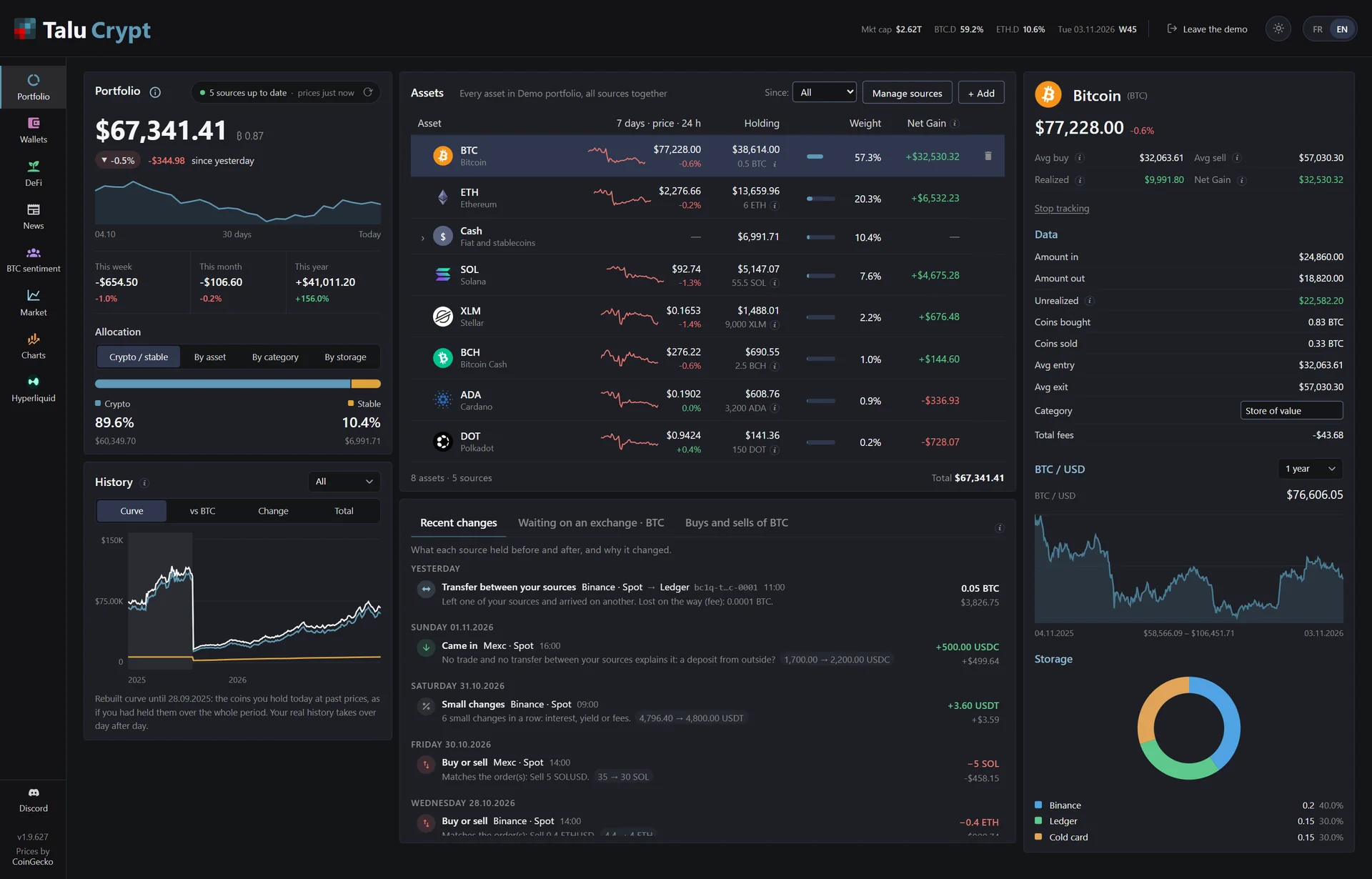
- Avg buy is the average price paid for the coins you still hold.
- Realized is what your sales locked in, Unrealized is the gain or loss on the coins you hold, and Net Gain adds them up, with fees.
- Coins with no recorded buy? Choose Enter my average buy price, then give What I paid in total or the Price per coin. It is saved as one buy that you can edit in Buys and sells.
These figures show where you stand. They are not financial advice, and they do not tell you what to do next.
Open the demo to see these figures on a sample portfolio, with no account. To work them out on your own coins, create a free account.